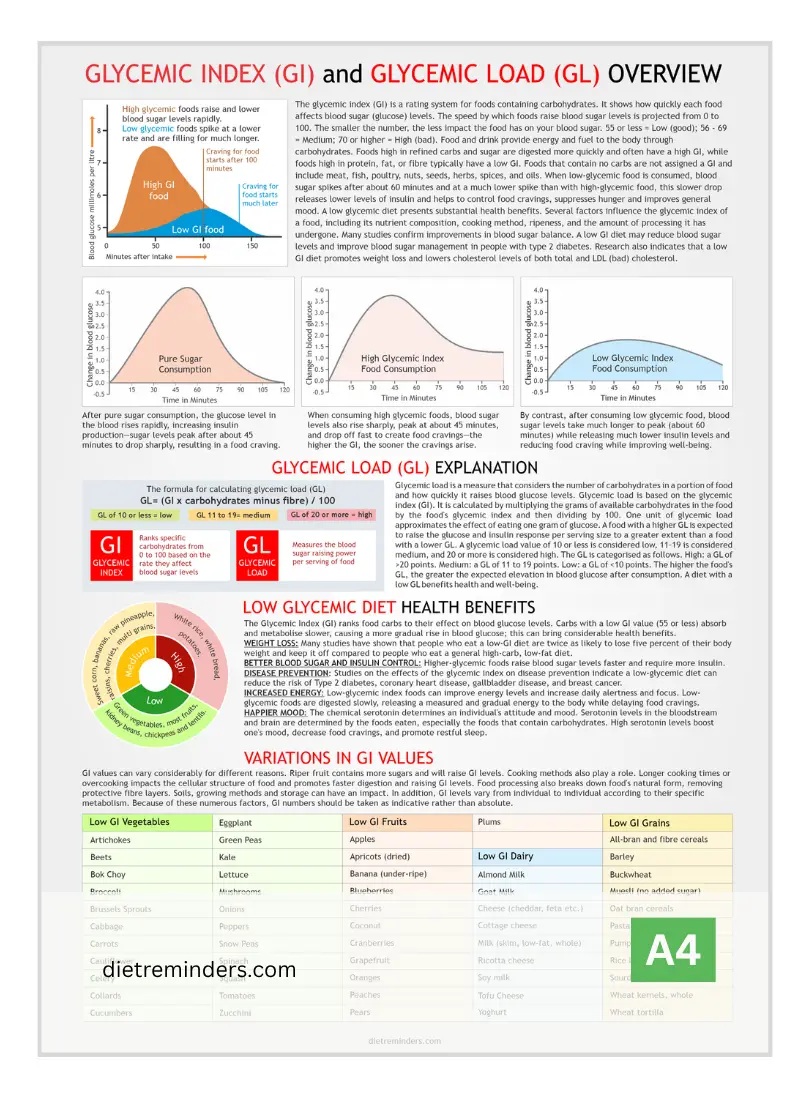
Comprehensive Glycemic Index (GI) and Glycemic Load (GL) Overview Chart explaining blood sugar response, GI/GL concepts and calculations, health benefits (weight loss, blood sugar control, disease prevention, mood improvement), blood sugar response curves, GI value variations, and extensive low-GI food lists by category (vegetables, fruits, grains, dairy). Essential educational reference for diabetes management and metabolic health. A4 printable PDF, instant download.
$4.00
Master blood sugar management with this comprehensive Glycemic Index and Glycemic Load Overview Chart—your essential educational guide explaining GI and GL concepts, how foods affect blood sugar, the critical differences between high and low glycemic foods, health benefits of low-GI eating, and practical food lists organized by category for implementing this powerful dietary approach to diabetes management, weight loss, and metabolic health.
This expertly designed educational reference transforms complex nutritional science into accessible visual learning, featuring blood sugar response curves, GI/GL calculation formulas, illustrated health benefits, and extensive low-GI food lists across all categories—empowering you to understand why glycemic index matters and how to apply this knowledge for optimal blood sugar control, sustained energy, appetite management, and disease prevention.
Understanding Glycemic Index (GI):
The Glycemic Index is a rating system for foods containing carbohydrates. It shows how quickly each food affects blood sugar (glucose) levels. The speed by which foods raise blood sugar levels is projected from 0 to 100. The smaller the number, the less impact the food has on your blood sugar: 55 or less = Low (good); 56-69 = Medium; 70 or more = High. Foods with a high GI are those that are rapidly digested, absorbed, and metabolised and result in marked fluctuations in blood sugar levels. Carbohydrates that break down quickly during digestion and release glucose rapidly into the bloodstream tend to have a high GI; those that break down more slowly, releasing glucose more gradually into the bloodstream, tend to have a low GI.
Visual graphs demonstrate:
Blood Sugar Response Curves:
Three detailed graphs show blood sugar response over time:
Glycemic Load (GL) Explanation:
Glycemic load is a measure that considers the number of carbohydrates in a portion of food and how quickly it raises blood glucose levels. Glycemic load is based on the glycemic index (GI). It is calculated by multiplying the grams of available carbohydrates in the food by the food's glycemic index and then dividing by 100. One unit of glycemic load approximates the effect of eating one gram of glucose. Glycemic load gives a more accurate picture of how a food is likely to raise the glucose and insulin response per serving size to a greater extent than a food with a lower GL. A glycemic load value of 10 or less is considered low, 11-19 is considered medium, and 20 or higher is considered high. For example, watermelon has a high GI (>70 points). Medium = GL of 11 to 19 points. Low = GL of <10 points. The higher the food's GL, the greater the expected elevation in blood glucose after consumption. A diet with a low GL is recommended.
The chart includes clear visual definitions:
GI ranks specific carbohydrates from highest to lowest, the rate they affect blood sugar levels
GL measures the blood sugar-raising power per serving of food
Low-Glycemic-Diet Health Benefits:
Illustrated with a circular diagram showing interconnected benefits:
The Glycemic Index (GI) ranks food carbs to their effect on blood glucose levels. Carbs with a low GI value (55 or less) absorb and metabolise more slowly, causing a more gradual rise in blood glucose; this can bring considerable health benefits.
Weight Loss: Studies indicate that low GI diets help people who are overweight or obese to lose five per cent of their body weight and keep it off compared to people who eat a general high-carb, low-fat diet.
Better Blood Sugar and Insulin Control: Higher-glycemic foods raise blood sugar levels faster and require more insulin, leading to greater fat storage. Low-GI eating helps maintain steady blood sugar levels.
Disease Prevention: Studies on the effects of the glycemic index on disease prevention indicate that a low-glycemic diet can reduce the risk of Type 2 diabetes, coronary heart disease, gallbladder disease, and breast cancer.
Happier Mood and Better Sleep Quality: Low-GI foods provide sustained energy throughout the day and improve focus. Low-glycemic foods are digested slowly, releasing a measured and gradual energy to the body while delaying food cravings.
Happier Mood: The chemical serotonin determines an individual's attitude and mood. Serotonin levels in the bloodstream are higher after eating low-GI carb-rich foods. This is why high-carb junk food can help with unhappiness; it can sometimes boost one's mood, decrease food cravings, and promote restful sleep.
Variations in GI Values:
GI values can vary considerably for different reasons. Riper fruit contains more sugar and will raise GI levels. Cooking methods also play a role. Longer cooking times often increase GI. The processing or refining of food products often raises GI. Fat or soluble fibre tends to lower GI. The form a carb is in also breaks down food's natural form, removing protective fibre layers. Soils, growing methods and storage can have an impact. In addition, GI levels vary from individual to individual. Because of these numerous factors, GI numbers should be taken as indicative rather than absolute.
Low GI Food Categories:
Low GI Vegetables: Artichokes, Beans, Bok Choy, Broccoli, Brussels Sprouts, Cabbage, Carrots, Cauliflower, Collards, Cucumbers, Eggplant, Green Peas, Kale, Lettuce, Mushrooms, Onions, Peppers, Snow Peas, Spinach, Grapefruit, Oranges, Tomatoes, Zucchini
Low GI Fruits: Apples, Apricots (dried), Banana (under-ripe), Blueberries, Cherries, Coconut, Grapefruit, Grapes, Oranges, Peaches, Pears, Plums
Low GI Grains: All-bran and fibre cereals, Barley, Buckwheat, Muesli (no added sugar), Oat bran cereals, Pasta, Pumpernickel, Rice (basmati), Rice vermicelli, Whole kernels, whole Wheat tortilla
Low GI Dairy: Almond Milk, Corn Milk, Cheese (cheddar, feta etc.), Cottage cheese, Milk (skim, low-fat, whole), Ricotta cheese, Soy milk, Tofu Cheese, Yoghurt
Perfect For:
Format: High-resolution printable PDF, A4 size (297×210mm) Delivery: Instant digital download
You can print on your printer or order a high-quality print from your local print shop. Have the print framed and display it in your home or office. A quality printout of this iconic image will also make a valuable gift.
Digital Download – Instant Access
You can view our digital PDF files on your desktop, phone, or tablet, or print them as often as needed—either at home or through a professional printing service. Bundles containing multiple files are delivered as a single ZIP file.
Upon purchase, you will receive an email with a download link immediately. If it doesn't arrive, please check your junk or spam folder. Still can't find it? Reach out via the CONTACT page, and we'll promptly resend the file as an email attachment.
Please note that we do not accept returns on digital products. Once you receive the download link, the product has been delivered and cannot be returned. By downloading the file, you acknowledge that your right of withdrawal is waived as the digital content has been delivered. If you have a specific issue, please contact us and we will definitely consider your case.
All products are delivered as high-resolution PDF files optimized for printing. Lost your download? Contact us within 30 days for a re-download link.
Our charts and lists are provided for informational purposes only and are not a substitute for professional healthcare advice. Always consult with qualified healthcare providers regarding any health concerns or before making significant dietary changes. While we strive for accuracy, nutritional information may change and should be verified for critical applications.
We respect your privacy and are committed to protecting your personal information. We collect only the essential details needed to process your order and deliver your digital products. Your information is never sold or shared with third parties.
If you experience any technical issues with downloading or accessing your files, please contact us immediately through our CONTACT page. We're here to help ensure you receive your purchase successfully.
All products are copyrighted by dietreminders.com. Files are for personal use only and may not be redistributed or resold. If you're a health professional interested in using our charts in your practice, please contact us about commercial licensing options.

